In collaboration with: Bibliothèque Nationale de France.
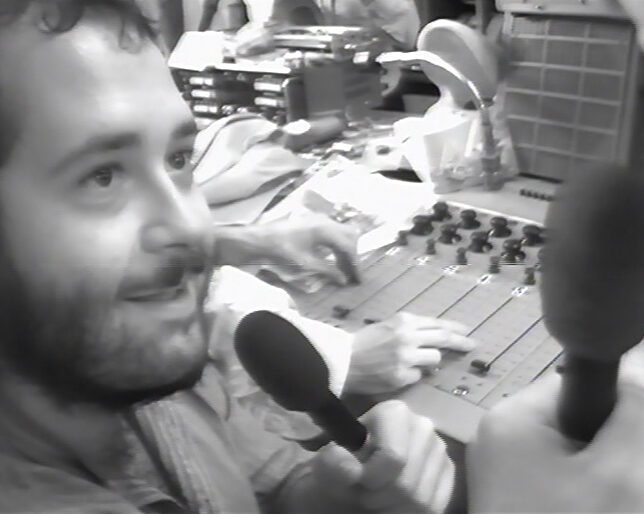
The film features a large delegation of Radio Alice figures who, after the station was shut down in March 1977, meet in Paris. The opening scenes were shot at the La Borde Clinic in Cour-Cheverny, where the group meets students of Félix Guattari. In a room decorated with stucco and mirrors, some of them broken, Franco Berardi recounts the story of Bologna and the origins of Radio Alice in French. The group then moves to a studio equipped with turntables and tape recorders, where accounts of the Bologna experience alternate with listening to records. The station’s history is reconstructed by Paolo Ricci, Matteo Guerrino, Ambrogio Vitali, Andrea Zanobetti, and Franco “Bifo” Berardi. Ricci, Guerrino, and Vitali speak in Italian, with Zanobetti translating, while Zanobetti and Berardi speak directly in French.
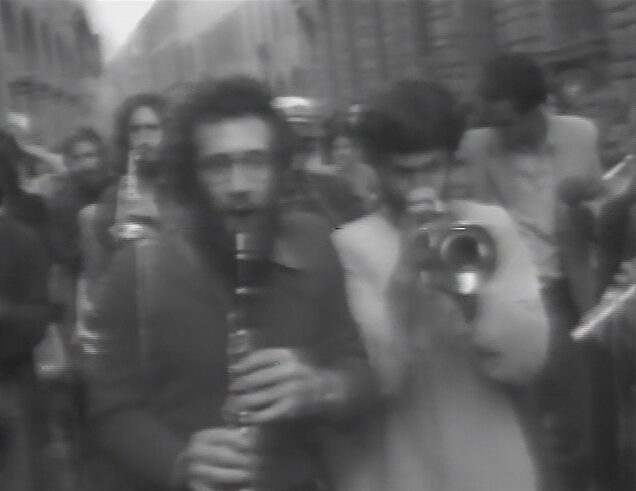
The film then cuts to an audio recording of Radio Alice’s final moments, subtitled in French against a black background, before moving to Bologna in the autumn of 1977, during the “September Conference.” A procession led by saxophonists and other musicians makes its way along Via Zamboni. In Piazza Verdi, amid music and interviews, a sign announces: “Alice is broadcasting via a radio link with the Cité Universitaire in Paris.” Through footage shot in Paris, Bologna, and Rome, the film revisits Radio Alice’s story just months after its closure, as well as the network of relationships and political experiences that continued to develop after March 1977. The documentary has never been shown in Italy, although it has screened at a number of activist groups in France.